

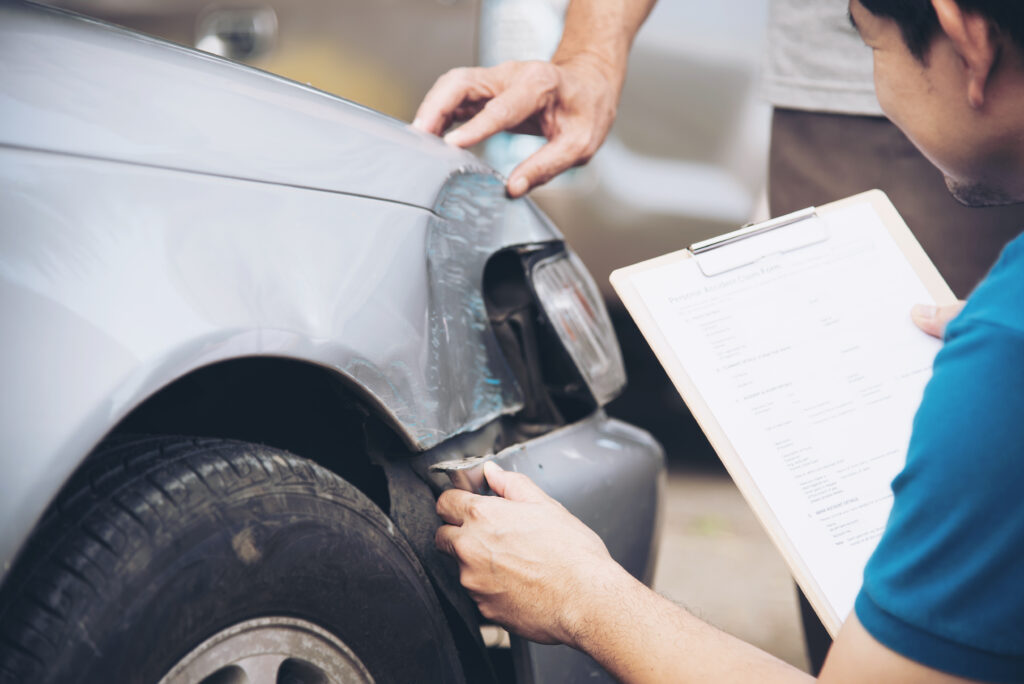
For a long time, the first thing a crash reconstructionist did at an intersection was read the pavement. Black rubber trails measured in feet, a scalloped yaw curve through the apex, maybe a gouge where a control arm bit the asphalt.
Plug the friction coefficient into the speed-from-skid-marks equation, add crush depth, and you had a defensible pre-impact number before the tow trucks pulled away. Today that same reconstructionist walks up to an electric sedan that cleared 60 mph in under three seconds, braked by shedding regen torque into the battery, and left almost nothing on the road to measure.
That shift isn’t academic. It changes which side of a claim has evidence, how fast that evidence disappears, and what the first 48 hours after a crash should look like for anyone caught up in one.
Why Don’t EV Crashes Leave the Marks Reconstructionists Expect?
Three vehicle characteristics can make traditional skid-mark evidence less useful in electric vehicle crashes.
First, regenerative braking slows the vehicle by using its electric motor to recover energy rather than relying entirely on friction brakes. This deceleration may leave no visible tire marks, even when the driver slows significantly before impact.
Second, anti-lock braking systems (ABS) help prevent wheels from locking during hard braking. Instead of producing the long, dark skid marks traditionally associated with emergency stops, ABS-equipped vehicles may leave faint or intermittent marks that are difficult to identify. This isn’t unique to EVs, but it adds to the challenge of reconstructing a crash from pavement evidence alone.
Third, rapid acceleration from electric motors can allow an EV to gain speed quickly without leaving obvious physical clues on the roadway. Investigators may need vehicle data and other evidence to establish how fast the car was traveling before the collision.
These factors don’t make traditional crash reconstruction impossible, but they increase the importance of electronic evidence. If a car accident attorney gets involved early, preserving that information can help establish what happened in the seconds leading up to the crash.
Where does the evidence live now?
Inside the car. Event data recorders have been standard equipment in passenger vehicles for years, and in late 2024 federal regulators finalized a rule that materially expands what those recorders capture. The NHTSA final rule stretches pre-crash recording from five seconds at two samples per second to twenty seconds at ten samples per second a tenfold jump in resolution and a fourfold jump in the window before impact.
On an EV that difference is enormous. The reconstructionist no longer needs a skid to infer braking. The log shows accelerator position, regen demand, friction brake pressure, steering angle, yaw rate, and stability-control interventions, sampled densely enough to see what the driver actually did in the final seconds. That record has to be preserved before the vehicle is repaired, auctioned, or crushed.
Does the physics itself change when the car weighs 6,000 pounds?
Yes, and this is the part the pavement never showed anyway. Battery packs make EVs substantially heavier than comparable combustion cars, and that mass turns up in crush depth, in intrusion into the lighter vehicle, and in the injuries a claim is built around. A study from Cambridge University Press examined how EV-specific traits silent operation, instant torque, and heavier curb weight shift both the frequency and the severity of crashes compared with combustion vehicles.
The practical consequence is that momentum calculations built on two cars of roughly similar mass have to be redone when one of them is an EV. A reconstructionist still runs the equations. The inputs have changed.
What should a driver or passenger actually do differently after an EV crash?
- Photograph everything on scene. Final rest positions, debris fields, any faint tire scuffs, and the condition of both vehicles — before anything is moved or towed.
- Note the car’s state. Whether the vehicle powered down on its own, whether high-voltage warnings appeared on the dash, and whether the 12V system was still active.
- Flag the data recorder in writing. Tell the insurer and the body shop, in writing, that the event data recorder and any telematics logs must not be overwritten, wiped, or reset during repairs.
- Do not authorize a software update. Over-the-air updates can change calibration values that a reconstructionist will later want to read as they were at the moment of impact.
- Request the vehicle be held. If liability is contested, ask that the car be stored intact rather than repaired or sent to salvage until the data has been downloaded by a qualified examiner.
Who still benefits from the old playbook?
Older vehicles without ABS, trucks with mechanical brake systems, and any crash where the responding officer measured and photographed marks before weather erased them. The speed-from-skid-marks equation hasn’t been repealed; it just applies to a shrinking share of the fleet.
For everyone else, the center of gravity in a reconstruction has moved from the pavement to the processor. The sooner that’s acknowledged after a crash, the better the record looks when the claim is finally decided.